
Finally: AI Slides you can Trust and Audit
Lampi's Slides - a source-backed, reviewable, editable AI presentation built for real professional standards.

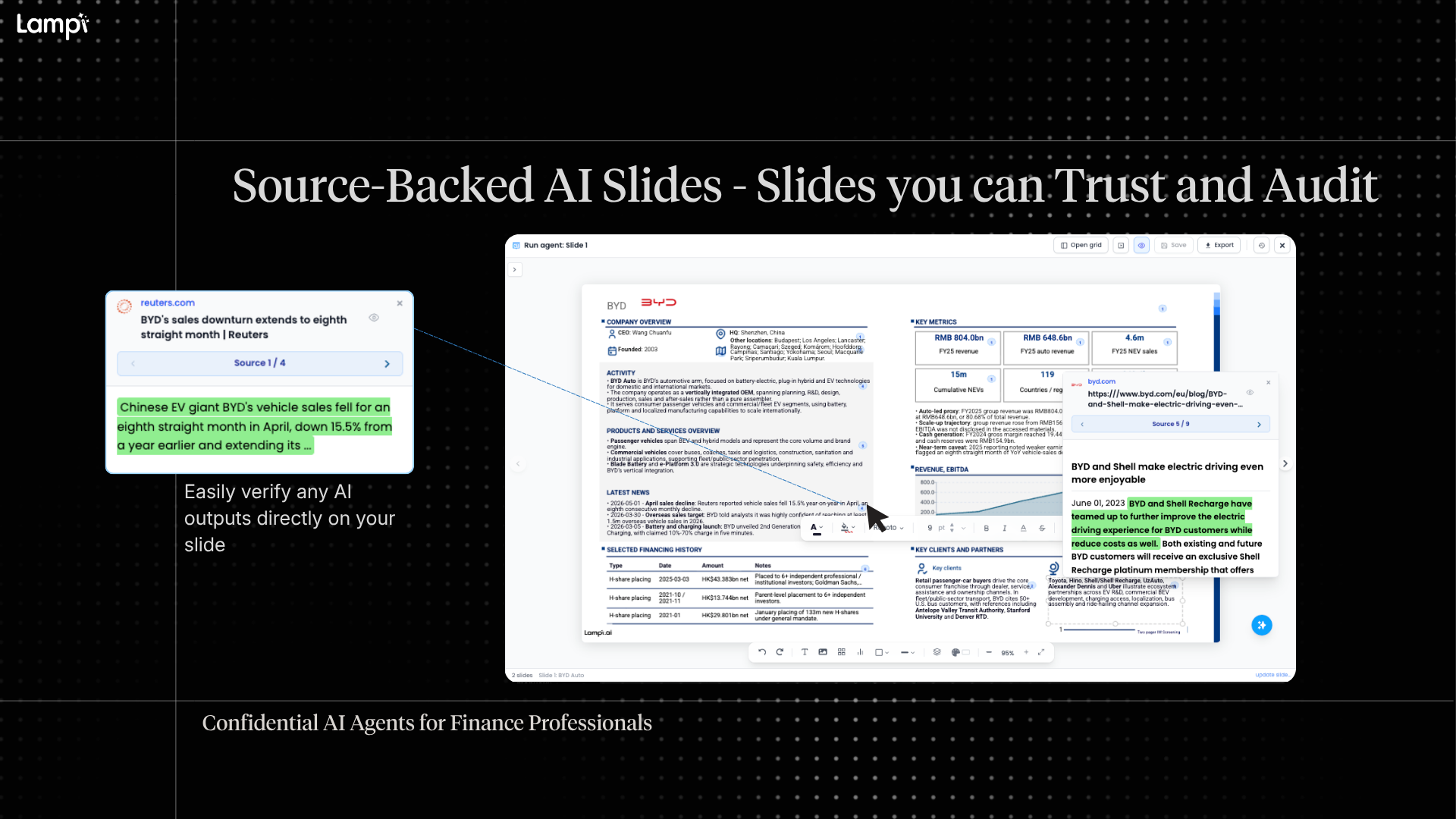
AI can now generate slides quickly. That is useful.
But in private equity, M&A, consulting, legal, and strategy work, speed is not enough. A slide is only valuable if the team can defend what it says.
A market-size estimate, a revenue bridge, a customer concentration point, a covenant risk, a management quote, a margin trend, a competitive benchmark — none of these can live as unsupported text in a presentation. If the deck is going to a partner, committee, client, lender, portfolio CEO, or board, the question is always the same:
→ Where did this come from?
That is the real problem Lampi AI is solving with source-backed slide generation.
The output is not just a deck. It is a reviewable deliverable where all insights, KPIs, tables, charts, and key slide objects can be checked against the underlying source. Inspect the work, validate the claim, and adjust the slide before it leaves the team.
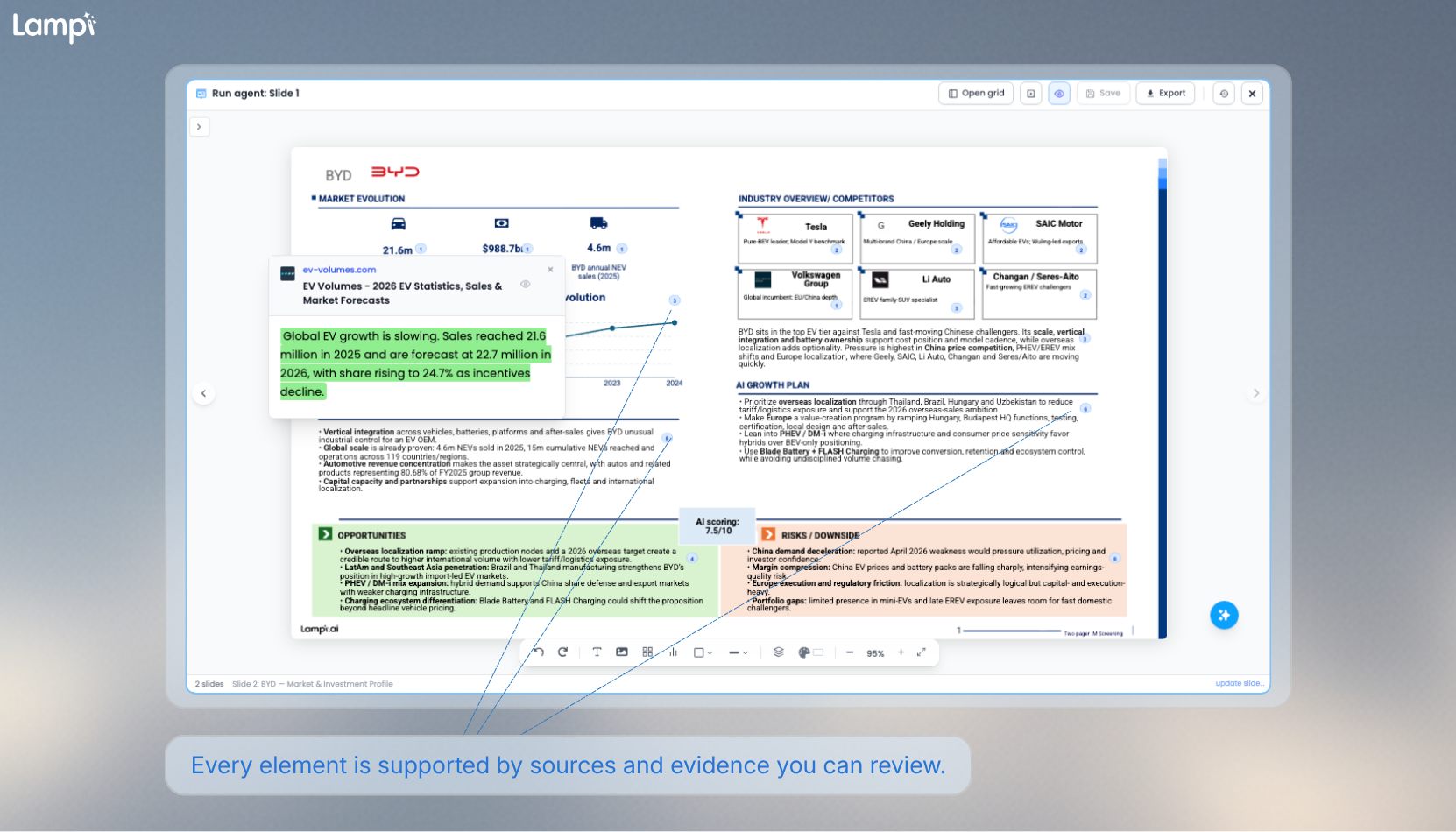
This is what makes AI usable in high-stakes professional workflows: not only the ability to produce, but the ability to verify.
The Problem with AI-generated Presentations
Most AI presentation tools can produce a clean slide. But professional users do not only review slides visually. They review them evidentially and ask:
- Is the revenue figure correct?
- Which source supports this market claim?
- Does this chart come from the right table?
- Is this quote from the management call, the CIM, or an external report?
That is where generic AI output breaks down.
If a slide looks polished but the sources disappear, the team has to redo the verification manually. Analysts end up checking every sentence, rebuilding every chart, searching back through documents, and wondering which source the AI used — or whether it used one at all.
The result is a trust gap.
The team may save time on drafting, but lose it again in review.
For professional workflows, unsupported AI output is not a productivity gain. It is another review burden.
Lampi’s Slides: The Source should stay with the Claim
In Lampi, the trust chain matters from the beginning of the AI agent's work to the final slide.
When AI agents search, analyze, extract, compare, and synthesize information, the sources behind the work should not disappear when the answer becomes a presentation. They should remain visible where the you need them most: inside the deliverable. That means you should be able to review the slide and understand which source supports the specific output in front of them.
The source needs to stay close to the exact claim, object, table, or chart it supports.
This changes the role of AI-generated slides. They are no longer black-box drafts that need to be recreated by hand. They become working deliverables that a professional can inspect, challenge, and refine.
The principle is simple:
The deeper value is that Lampi compresses the path from research to analysis to reviewable deliverable without breaking the source trail.
In high-stakes workflows, every output has two jobs:
- Communicate the answer clearly.
- Preserve the evidence needed to defend that answer.
Most AI systems focus on the first job. Lampi is built for both.
Focus on judgment: what to keep, what to adjust, what to challenge, and what to escalate. That is the difference between AI as a drafting shortcut and AI as a serious workflow layer.
Review each Step before you Trust the Slide
Citations are essential, but complex agentic workflows need more than proof at the end. Teams also need visibility into the intermediate answers that shaped the final slide.
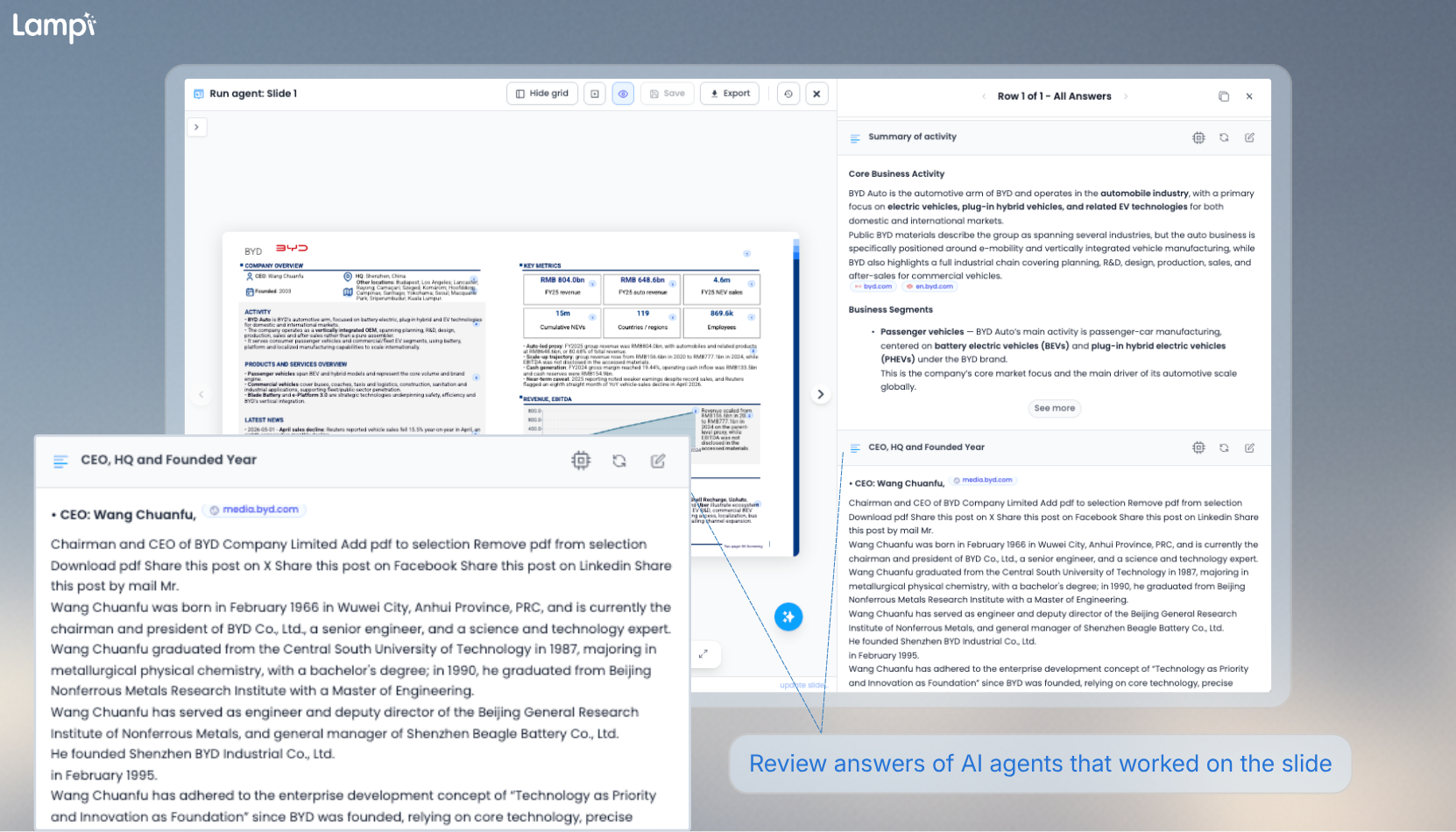
With Lampi Grid, teams can review the work behind the deck. Each step of agent produces a specific answer that can be inspected:
- what Lampi searched,
- what it found,
- which sources have been investigated, and
- how it interpreted the available context.
That matters because business work is rarely a single prompt and a single answer. A strong slide may depend on dozens of small decisions: which sources were selected, which details were kept, which risks were summarized, which numbers were compared, and which insights were promoted into the narrative.
Lampi makes those steps visible and auditable, so users can catch missing details or easily challenge an interpretation.
The result is transparency from the agentic process to the presentation itself. You can review the reasoning behind the work, inspect the evidence behind each step, and then verify the source behind each slide insight. The final deck is not a black box. It is the visible outcome of a workflow you can audit, edit, and trust.
Conclusion: AI Is Useful When You Can Trust the Output
AI-generated slides will become common. That part is obvious.
The harder question is which outputs professionals will actually trust enough to use.
In private equity, M&A, legal, consulting, and strategy workflows, the answer will not be the deck that looks best in a demo. It will be the deck where the user can inspect the source, verify the claim, adjust the content, and still leave with a presentation that meets the firm’s standards.
That is the direction Lampi is building toward.
Source-backed slide generation is about making AI-generated deliverables reviewable enough for serious work.
Because in high-stakes workflows, trust is not a nice-to-have feature.
It is the condition for adoption.
At Lampi AI, we build AI agents for Finance Professional firms — purpose-built for the deal lifecycle. If you are looking for a way to generate source-backed, reviewable, and editable presentations: